As a business that specialises in buying and selling gold, fine jewellery and luxury watches, we often meet people that want to sell their gold items. There are many reasons for coming to this decision, but commonly we find it’s because the individual wants to upgrade to something else, simply fancies a change, or they want to realise the asset into cash. In light of this, we carry out daily valuations on a huge range of individual items of jewellery. Of course, as experts, we have a well-trained eye for what is real and what’s not. For those that are unsure as to how to tell genuine gold from fake gold, it can be a little trickier.

While the best way to be sure of the authenticity of your gold is to bring it along and have it inspected by our experienced team, there are other tell-tale signs that should help you establish if your piece is the real deal.

The most widely recognised go to bench mark for this is called a ‘hallmark’.

What Is A Hallmark?

Perhaps the best way to tell the difference between real gold and fake is by looking for what is called a ‘hallmark’. Be mindful real gold doesn’t always carry this stamp, depending on a range of factors including which country it was produced in, the age of the item, the style of the piece and how much wear and tear it has had. Many countries however, do have a hallmarking system.

Here’s what to look for:

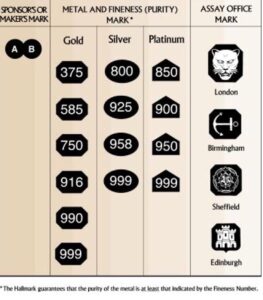
Until 1998, a Hallmark had to include four compulsory marks.  Since 1998, this has reduced to three (the date letter has become optional).

how to tell real gold from fake gold

The symbols must include:

  • The maker’s stamp – who made the item
  • It’s guaranteed standard of fineness – is it 9ct, 18ct, 22ct etc.
  • Assay Office at which the article was tested and marked
  • The year that the article was tested and marked (not compulsory on more modern pieces)

As mentioned above, with pieces made since 1998, the date mark is no longer compulsory.

In the example below, the RJ symbol is the maker’s mark. The crown refers to gold and is an optional mark. The number 375 represents 9ct gold and is the standard mark to verify the fineness of the metal. The lions face is the symbol of the London Assay Office where it was verified.

hallmark

These symbols tell us that this is a 9ct gold ring that has been certified by the London Assay Office and is therefore a genuine piece of gold. It tells us everything we need to know in order to provide an accurate valuation of the item.

You can find a full explanation here.

No Hallmark

If the piece is not hallmarked, it is much harder to tell and you will need to get it verified by an expert who is trained to differentiate real gold from gold plated metals using other methods. Even if the item is verified as real, it can be tricky for the jeweller to resell the item without a hallmark so please bear this in mind.

NOTE

While something might contain gold, it needs to be a certain purity to have value. Anything that is less than 37.5% or 9cts of gold is considered fake in the UK market.

DIY Ways to Spot Fake Gold

Not by any means conclusive or fool proof, these “do it yourself” home tests may assist with how to spot real gold from fake or plated:

Does it Float?

Drop your ring in a jug full of water. Gold is denser than other alloys and will sink to the bottom. If your item is fake, it will likely float although this is not the case in all circumstances.

Try the Vinegar Test

If you drop a few drops of vinegar onto a ring and wait 15 seconds, real gold won’t change colour. Fake gold will.

Look for Faded Spots

If your ring is gold plated, over time the plating will wear away and you may find that your ring, necklace, bracelet etc is discolouring. Solid gold will not discolour so this is a pretty obvious sign that item is genuine.

Does it Leave Green Marks?

If your jewellery leaves a green mark on your skin after wearing it, it’s a sign that you are possibly wearing copper. Ever seen what happens to bathroom pipes etc? Over time they too can become green. This is the same with any copper that is exposed to the elements.

If your item is a mixture of gold and other base metals, the same may happen so this is not a definitive that your jewellery is not gold to some extent, but will give you an indication.

Understanding the Value of Your Jewellery

If you own a sentimental piece of jewellery and are unperturbed as to whether it is real gold or fake gold then you need not worry. The meaning is there to you regardless of its intrinsic worth.  If you want to ascertain the monetary value of something for insurance purposes however, then it is prudent to understanding your jewellery, or jewellery collection and arrange to have it formerly assessed. If you are looking to sell something and want to know if what its worth, getting the right price for your gold is key.

At The Goldmarket, our staff are trained to identify real gold from fake gold and are also licensed and certified to carry out written insurance valuations on items. In addition to this we buy gold at competitive prices and also purchase items of jewellery for resale. If you have a piece of jewellery that you would like valued, please bring it along to our High Street store in Weston super Mare and our friendly, expert team will be only too happy to help.


It’s the same story every year and has been since the year 1916. Every spring and every autumn, we have to change the clocks. As we get used to one season, it’s all change and we either welcome lighter nights or say goodbye to some daylight. But why do the clocks change and how did this tradition begin?

Why Do the Clocks Change?

The tradition of changing clocks was first suggested by William Willett in 1907. He wanted to introduce lighter evenings in the summer months and stop the waste of early morning day light. It was in 1916 that British Summer Time was passed as an Act of Parliament.

Since this time the clocks have moved forward an hour in spring and back an hour in autumn. The only exception was during the Second World War.

Which Way Do They Go?

Many people get confused over whether the clocks go back an hour or forward an hour. It doesn’t matter how old you are – it can often cause confusion. The easy way to remember it it ‘spring forward and fall back’ They go forward one hour in spring on the last Sunday of March at 1am, making the time 2am, and then back one hour on the last Sunday of October at 2am making the time 1am. This process is known as British Summer Time or Daylight Saving Time.

What is the ‘Correct’ Time?

Greenwich meantime, or GMT as it is known, is the yearly average (or ‘mean) of the time each day when the sun crosses the Prime Meridian at the Royal Observatory Greenwich.

If we didn’t change our clocks, we would all operate on GMT which doesn’t change for BST. In fact GMT is shown on the Shepherd Gate clock which can be seen at the gates to the Royal Observatory and which is never changed.

Changing the Clocks

For many years, clocks had to be changed manually with delicate clocks having their hands moved twice a year. Then came the age of cars when the clock car was a mystery to be solved by many. Some people just used to leave their car at the same time all year round without moving it – at least it was correct for 6 months of the year.

The Digital Age

With the advance in technology, many of us don’t even realise that the clocks have changed. We go to sleep and wake up to discover all of our smart and digital devices have been updated.

Changing a Watch

For those that own a watch including a Rolex or Omega, there is a particular method to changing the time. Unfortunately, as sophisticated as these timepieces are, they don’t change themselves. Let’s take Rolex as an example and give you some tips on how to set the date and time.

Quickset Rolex Adjust

  • Step 1 – All Rolex watches have a screw-down winding on the outer edge. This screw-down function is used to change the date and time as well as to enhance water resistance
  • Step 2 – Unscrew the winding crown counter clockwise until it releases from the casing
  • Step 3 – Rotate the crown clockwise to manually wind the watch. The number of turns required will depend on your model. Most will be 25 revolutions but it can range from 20-40. You will need to check your watch manual or contact us for this info
  • Step 4 – Pull the crown head to the first notch. You will notice that the time hands continue to move
  • Step 5 – To set the date you need to rotate the crown first setting the date to the day before today
  • Step 6 – To set the time, pull the crown to the second notch. Rotate crown clockwise or counter clockwise.
  • Step 7 – Set the time to midnight – today’s date will appear
  • Step 8 – Now set the time accordingly taking into consideration whether it is PM or AM
  • Step 9 – Press the crown head back into the case to lock it. Wind it in a clockwise direction to ensure it is secure to the body of the watch. Never leave a winding crown screwed up as this can allow dust and moisture into the watch

Non-Quickset Rolex Adjust

  • Step 1 – Locate the screw-down winding and unscrew until it releases from the casingNow manually wind the watch
  • Step 2 – Pull out the crown to the second notch (skip past the first notch)
  • Step 3 – Rotate crown in either direction until correct date appears ensuring it is either am or pm.
  • Step 4 – Now set the correct time
  • Step 5 – Push the crown securely back to the casing

Should you have an issue with setting the time or date on your watch, we would be happy to assist. Just pop into The Goldmarket, WSM and let us help.


To the untrained eye, spotting a real diamond from fake can be a real dilemma. How do you tell what’s real and what’s not? How can you be sure that you aren’t going to get ripped off to the tune of hundreds, or even thousands, of pounds? How to tell a real diamond from a fake is a job for the experts but there are a few tell tale signs that can help you spot a fake. Before you part with your hard earned cash, we share the benefit of our experience and offer you some real pearls of wisdom! 

A fake diamond is what’s known as a synthetic diamond – one that is produced in a lab or ‘above the ground’. Unlike those found in the ground, they are mass produced for the unsuspecting market and hard for the untrained eye to spot. They are for all intense and purposes diamonds, just not the pure ones you find in the ground therefore they don’t have the same value as a real mined diamond. 

There are a few tests and methods that you can try yourself which may help you to spot a synthetic diamond from an organic one which will also make anyone trying to sell you a fake, uneasy too!

The Line Test

Place the diamond on a single black like drawn on a piece of white paper. The black line will appear more visible through a fake diamond. With a real diamond, the line will virtually disappear! This is because white light bends when passing through a diamond.

Weigh Your Diamond

Possibly the simplest way to tell if a diamond is real. A 5mm round diamond should weigh almost bang on 0.50ct. It may be a few points either side but it will be there or thereabouts. A cubic zirconia of the same size will be weightier. The chart below shows you what your diamond should weight if it’s real.

The Breath Test 

If you breathe on a genuine diamond, the moisture beads that form will quite quickly disappear. If the diamond is not real, the moisture will fade much more slowly. This method is used by many experts to spot a fake from a real diamond. The simple truth is that diamonds are the best thermal conductors on the planet. 

Touching a Rock with Your Tongue 

While writing this we have visions of people licking their diamonds to test this theory but it really is something that can only be determined by an expert. The feel of a diamond on the tongue is much different than a non-diamond due to that icy feel and the thermal conductivity we mentioned above. A diamond will take the heat away from the surface of your tongue. 

If it Looks Too Good to be True….

Sadly, if it looks too good to be true then it probably is! If your diamond looks flawless, is very in white in colour and has no visible imperfections, you are probably looking at a fake. While flawless diamonds to exist they tend to be out of many peoples price range. To ascertain a diamonds authenticity, magnifying equipment is required. 

How Sharp are the Facets?

A diamond has very sharp facets when compared to CZ stones which tend to have more rounded ones. Again, magnification is required if you want to look in fine detail. A diamond never loses the sharpness of the facets.

Wear on the Diamond 

Genuine diamonds don’t wear like other gemstones. One reason that the popular “diamonds are forever phrase” was coined. They keep their sharpness and so don’t chip or scratch. If a diamond looks worn and tired, it’s probably not the genuine article. This is a great indicator of how to spot a real diamond from a fake if you are buying a vintage piece. 

Does it Have Small Marks?

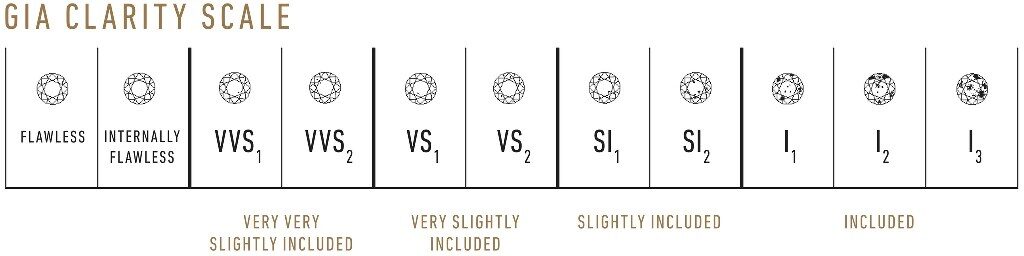
Genuine diamonds, unless flawless, have small marks which are known as inclusions. There is a grading scale of how included a diamond is which is used as one of the considerations when valuing a diamond. If your diamond has no inclusions it’s either worth a small fortune or it’s not real. 

guide to choosing diamonds

Still Not Sure?

If you’re not convinced and none of the above tests have made your mind up, we are happy to help. We provide experienced, professional diamond valuations for sale and insurance purposes and have the knowledge and skill to accurately assess your diamond. If you need help and advice with how to spot a real diamond from a fake, get in touch with us and we will offer the benefit of our experience to help you find your perfect gemstone. 

Just give us a call on 01934 628361 or pop along to 24 High Street, Weston-super-Mare where we will be happy to help.